An independently reviewed Life Cycle Assessment of Ascend Elements’ NMC 9.5.5 pCAM product
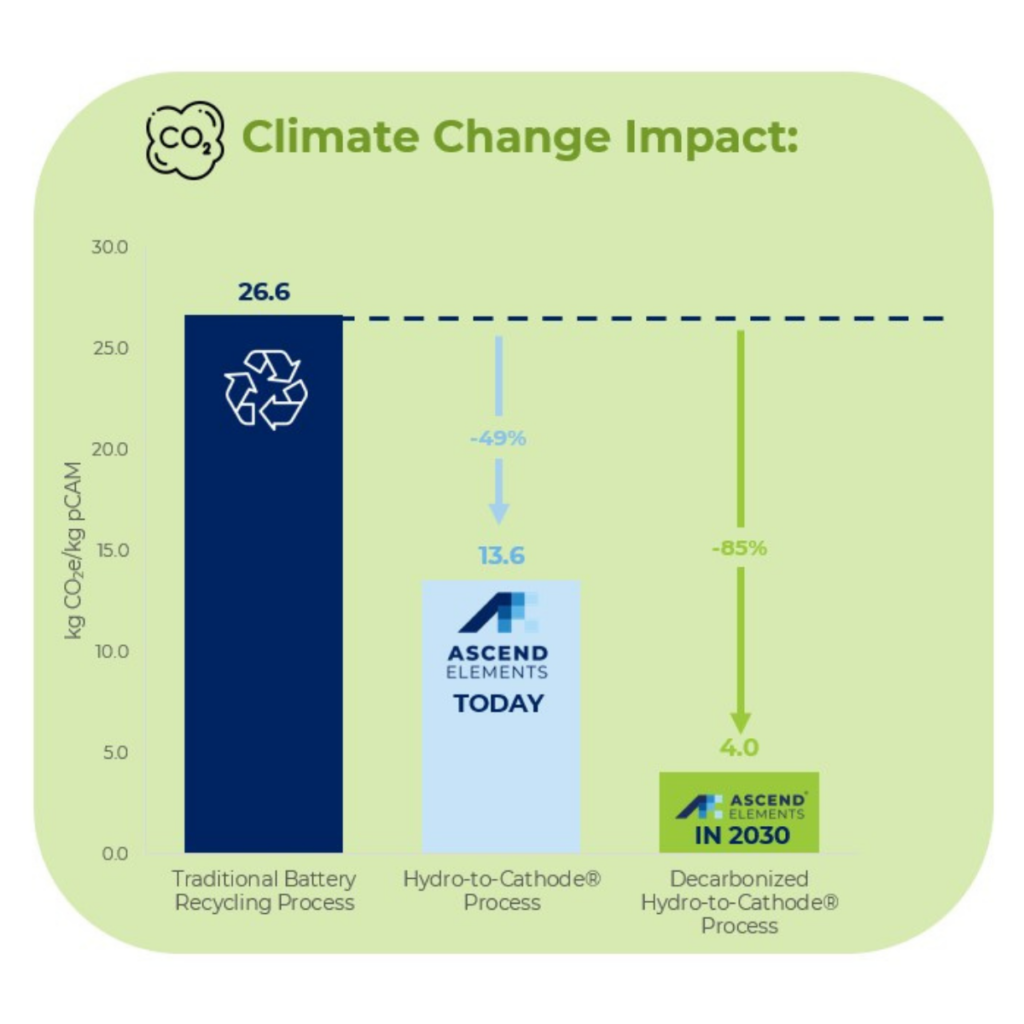
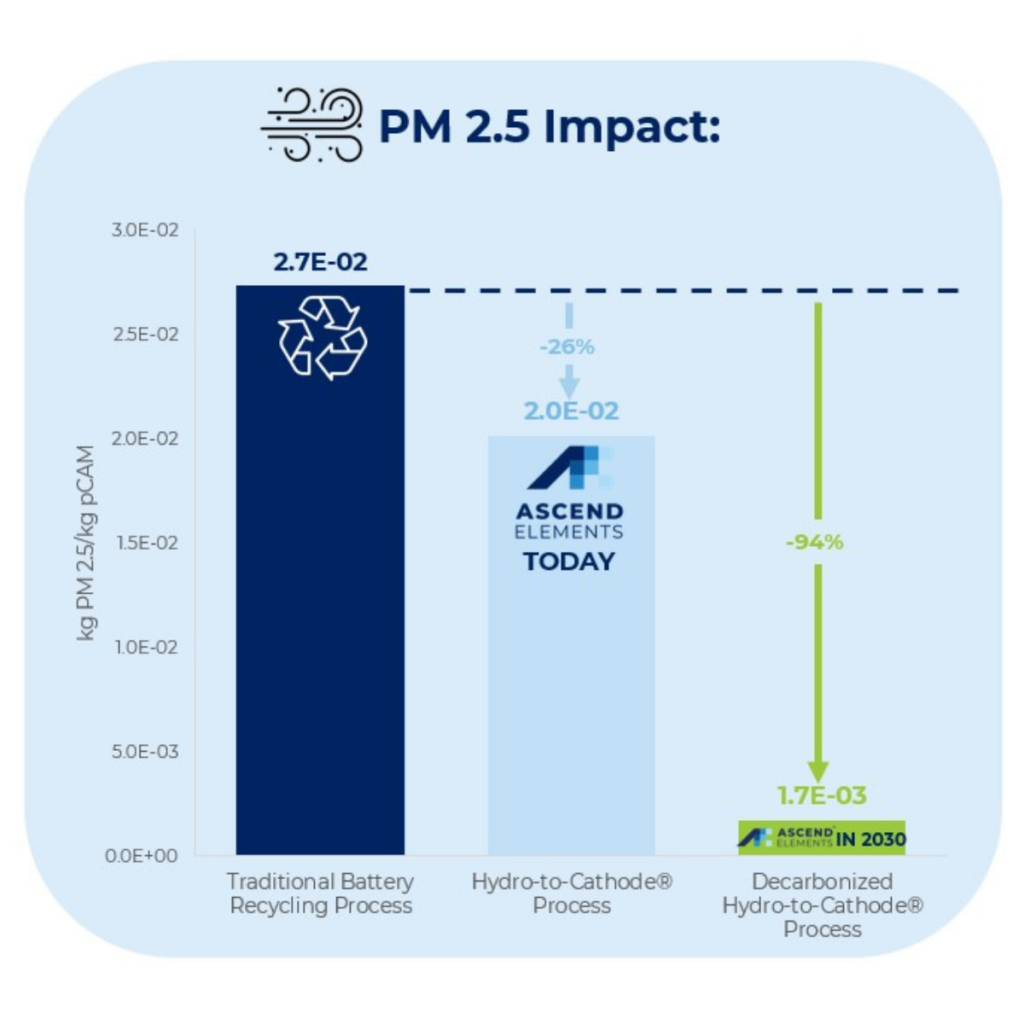
WESTBOROUGH, Mass., (April 22, 2025) — An independently reviewed Life Cycle Assessment (LCA) published today finds Ascend Elements’ innovative Hydro-to-Cathode® direct pCAM synthesis process is significantly cleaner than traditional battery recycling methods – producing 49% lower carbon dioxide equivalent (CO2e) emissions and 26% lower particulate matter 2.5 (PM 2.5) emissions. By 2030, Ascend Elements aims to achieve 86% lower CO2e emissions and 94% lower PM 2.5 emissions through additional decarbonization efforts, including 100% renewable energy use in recycling and manufacturing operations, rail transportation of materials, and application of lower-carbon reagents during production processes. The study was conducted in accordance with the ISO 14040:2006 and ISO 14044:2006 standards and critically reviewed by Minviro with a panel of three independent LCA experts.
“Battery recycling is the most efficient way to source critical battery materials, but not all recycling technologies are the same. We’ve been developing our Hydro-to-Cathode® process since 2011 with a focus on efficiency, economics and emissions,” said Eric Gratz, Ph.D., Co-founder and CTO at Ascend Elements. “This LCA demonstrates that our innovative processes are the cleanest and most efficient ways to return used battery materials to the domestic supply chain.”
In addition to pCAM, the study also analyzed Ascend Elements’ innovative process for recovery of lithium from recycled batteries and manufacturing scrap. Today, Ascend Elements’ production of 1 kg of lithium carbonate (Li2CO3) emits just 2.3 kg of CO2e, which is 86% lower than spodumene mining (16.8 kg of CO2e per 1kg of Li2CO3) and 37% lower than Chilean brine extraction (3.6 kg of CO2e per 1kg of Li2CO3). With the company’s decarbonization plans, it aims to reduce emissions to only 0.2 kg CO2e per kg Li2CO3 by 2030, which represents a 99% reduction compared to traditional methods.
PM 2.5 emissions are similarly reduced with Ascend Elements’ innovative lithium recovery process. According to PM 2.5 emissions data in the LCA, Ascend Elements’ Li₂CO₃ product is 97% less polluting than spodumene mining and 81% less polluting than Chilean brine extraction. By 2030, the company aims to reduce PM 2.5 emissions by 99.7% compared to spodumene mining and 98% compared to Chilean brine extraction.
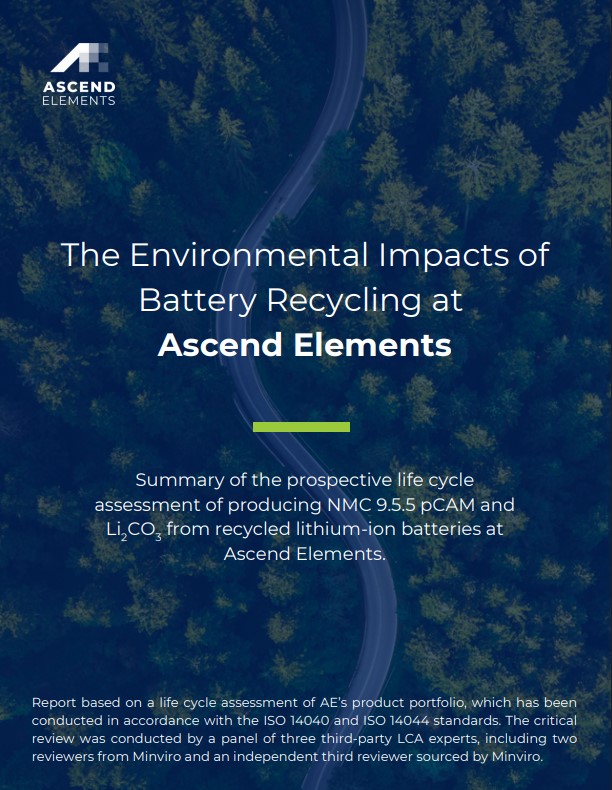
A summary of the new LCA Study is available for download. Emissions data for the “traditional battery recycling method” is based on a published LCA study that used a combination of both pyrolysis and hydrometallurgy processes.
Ascend Elements operates one of North America’s largest battery recycling facilities in Covington, Ga. A new lithium recovery line at the Georgia plant is expected to produce up to 3,000 metric tons of Li₂CO₃ annually. In Hopkinsville, Ky., the company is building an advanced Hydro-to-Cathode® pCAM manufacturing facility to produce engineered battery materials for up to 750,000 electric vehicle batteries annually. When operational in late 2026, the facility will be North America’s largest pCAM manufacturer.
About Ascend Elements
Ascend Elements is a North America- and Europe-based battery materials leader converting spent lithium-ion batteries and manufacturing scrap into premium precursor cathode material (pCAM) and battery-grade lithium carbonate through its patented Hydro-to-Cathode® process. With plants operating at scale and a proven technology platform, Ascend delivers circular supply for EV and energy storage markets. For more information, visit www.ascendelements.com.
.
MEDIA CONTACT:
Thomas Frey, APR
Ascend Elements | [email protected] | +1.734.658.0143